
Honest Chimney Repointing Short Hills NJ: 2026 Guide for Short Hills Residents
Most homeowners don’t think about mortar until a chunk of it lands on their patio. That’s usually when we get the call. Chimney repointing Short Hills NJ is one of the more common masonry jobs we handle each season, and it’s also one of the most misunderstood not because it’s complicated, but because the damage tends to build quietly for years before it becomes obvious. By the time mortar is crumbling visibly from the exterior, water has often already worked its way into joints lower on the stack, and occasionally into the flashing line itself.
We want to walk you through what chimney repointing actually involves from start to finish what we’re looking for, how we diagnose it, what the work looks like on a real chimney, and what you can realistically expect when the job is done. No vague reassurances.
What Brought Us to a Colonial on Chestnut Street, Union
Last fall, a homeowner on Chestnut Street in Union called us after their real estate attorney flagged a chimney issue during a pre-sale inspection. The home was a 1940s brick Colonial the kind of solid construction you see throughout Union, Millburn, and Short Hills, where full-brick exteriors and multiple flue chimneys were standard. The inspection noted “deteriorated mortar joints” and recommended evaluation before closing. The Insurance Information Institute notes that a failed chimney inspection can delay or derail a real estate transaction, and in this case, the buyers had already requested a credit.
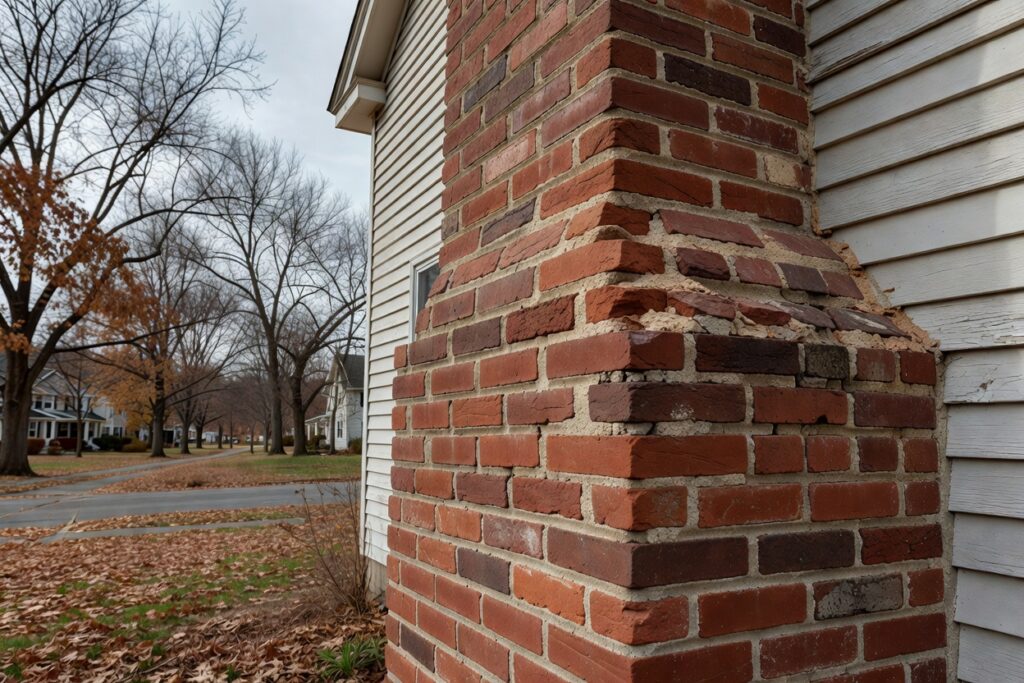
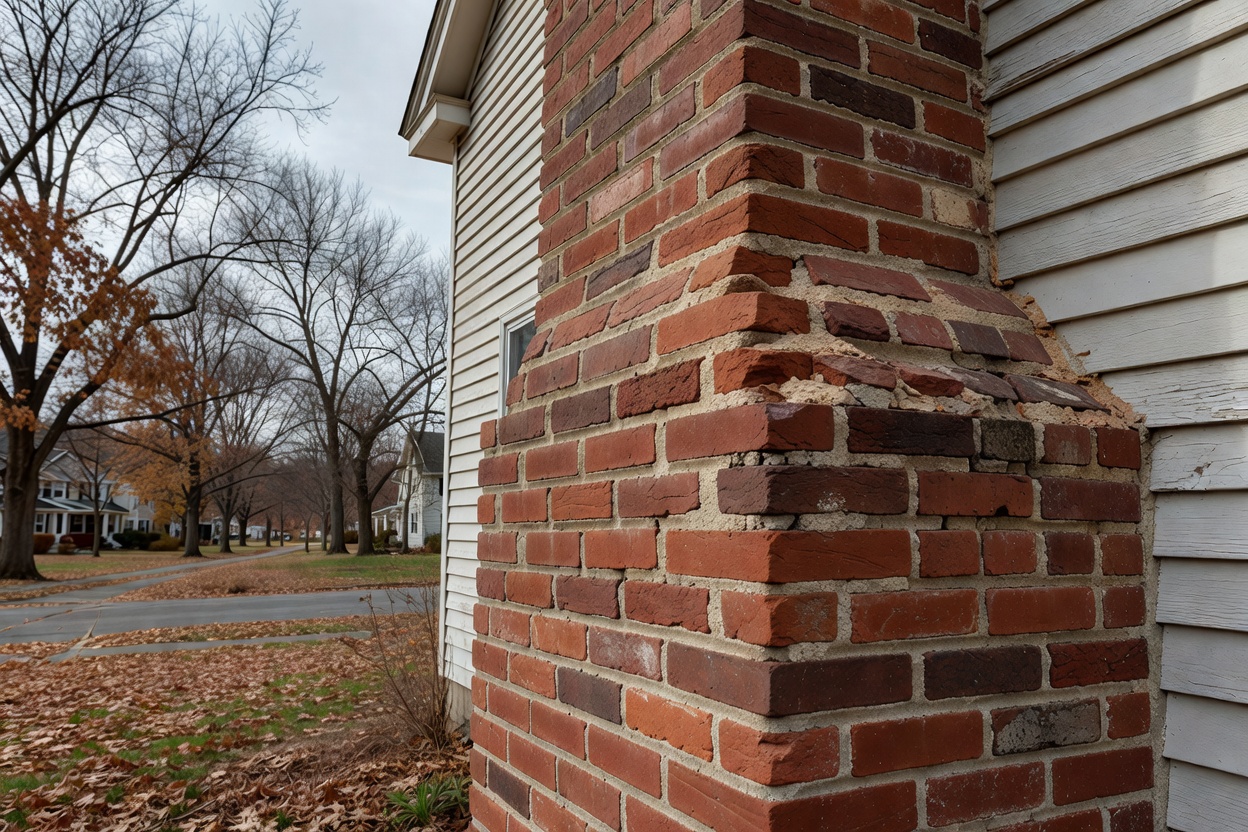
When we got up on the roof, what we found was typical of a chimney that had gone about fifteen years without attention: upper joints were soft and recessed a quarter-inch or more, the crown had a hairline crack running toward the northwest face, and several joints near the flashing had opened enough to accept a car key. The brick itself was in reasonable shape no significant spalling. That’s the good news about catching repointing before freeze-thaw damage advances to the brick face.
The Problems We Diagnose and How We Actually Read Them
Repointing isn’t a single uniform job. What we find on each chimney determines the scope, the mortar mix, and sometimes whether additional repairs need to happen first. Here’s how we think through the most common presentations.
Recessed or Powdering Joints
The most straightforward presentation: mortar that has receded behind the brick face, sometimes to a depth of half an inch or more, and that crumbles when you press it. The likely cause is age combined with water infiltration. Mortar has a functional lifespan typically 25 to 30 years on an exposed chimney in New Jersey’s climate. According to the National Chimney Sweep Guild (NCSG), New Jersey’s freeze-thaw climate cycles are among the most damaging to masonry chimneys, causing spalling, cracked crowns, and deteriorating mortar joints that worsen each winter if left unaddressed. When water enters a recessed joint and freezes, it expands, widening the gap. Each cycle opens it a little more.
The fix requires removing the failing mortar to a minimum depth of three-quarters of an inch enough to give new mortar a mechanical key and packing in fresh mortar matched to the original. Matching the mix matters. Modern Type S or Type N mortar is softer than the Portland-heavy mixes sometimes used in mid-century repairs. If the replacement mortar is harder than the surrounding brick, it can cause the brick itself to crack under thermal movement. We test older masonry before we mix.
Isolated Joint Failure Near Flashing
Joints that fail specifically around the base of the chimney, near the roofline, often indicate a flashing problem rather than simple mortar age. Water backing up under failed step or counter flashing erodes the mortar from the inside out. If we repoint those joints without addressing the flashing, the new mortar fails within a season or two. On the Union job, we found exactly these the lower two courses above the roofline needed both repointing and a flashing re-seal before the work would hold.
Horizontal Joint Failure on the South or West Face
When deterioration is concentrated on one face usually the south or west exposure on chimneys in our area ultraviolet degradation and direct weather exposure are the primary drivers. These chimneys get sunbaked and rain-hit simultaneously. The diagnostic here is visual: uniform erosion on one face, sound joints elsewhere. The repair is straightforward but tedious because you’re working one face at a time, and proper curing between sessions matters.
Soft Mortar That Looks Intact
This one surprise homeowners. Sometimes mortar looks fine from the ground the joints appear full, the color is consistent, but when we probe with a pointing chisel, the mortar has no compressive strength. It’s essentially sand. This happens when repointing was done poorly at some earlier date, often with an incorrect mix or during temperatures that were too cold or too hot for proper curing. We’ve seen this on chimneys in Maplewood and Livingston where previous patch work done without proper joint preparation failed silently. The fix is the same as any other repointing job, but first we have to remove what looks like good mortar. That conversation with homeowners takes some setup.
Cracked Joints at Corners
Corner joints crack differently than field joints. They’re subject to more thermal stress because the two faces of a corner expand and contract at slightly different rates. When we see a consistent crack pattern following the corners of a chimney top especially on older double-flue stacks common in Short Hills Tudors we’re looking at structural movement as much as mortar failure. Sometimes this means the crown needs attention before repointing, and occasionally it points to a footing issue, though that’s rare. More often it’s simply age and thermal fatigue.
What the Work Looks Like When We’re There
We use an angle grinder with a tuck-pointing blade to cut failing mortar not a hammer and chisel alone, which can crack brick if the technician is off by a millimeter. On a full chimney repoint, expect us to be on the roof for most of a day on a standard single-flue stack, longer on larger chimneys. We work in sections, keeping fresh mortar joints damp during curing if temperatures warrant it. The final step is tooling the joints pressing and shaping them to match the original profile, whether that’s a concave, weathered, or flush finish. Joint profile affects how water sheds off the face, so we don’t skip this step or leave it inconsistent.
The NFPA Standard 211 recommends that chimneys, fireplaces, and vents be inspected at least once a year for soundness, freedom from deposits, and correct clearances and mortar joint integrity is part of that assessment. A Level 1 inspection will typically surface repointing needs before they become expensive structural problems.
Can This Be Prevented
Partially. You can’t stop mortar from aging, but you can slow water infiltration with a professional-grade chimney waterproofing sealant applied every five to seven years. The sealant has to be vapor-permeable masonry breathes, and trapping moisture inside the brick is worse than letting rain hit it. We apply this as a follow-up service on most repointing jobs we complete in Short Hills, Chatham, and Summit. Annual inspections also catch early joint erosion before it advances to the point where brick faces are at risk.
Frequently Asked Questions
How do I know if my chimney needs repointing or a full rebuild?
Repointing addresses failing mortar joints while the brick itself remains structurally sound. A rebuild partial or full becomes necessary when brick faces are severely spalled, when the chimney has shifted or leaned, or when the damage has penetrated deep enough that new mortar has nothing solid to bond to. Our technicians assess this during inspection using a probe and, where needed, a camera scan of the flue interior. Most chimneys in Short Hills and Union that show surface joint erosion are good repointing candidates, not rebuild candidates.
What does chimney repointing in Short Hills NJ typically cost in 2026?
On a standard single-flue chimney in the Short Hills and Union area, repointing runs roughly $400 to $900 for targeted work on two or three deteriorated faces. A full perimeter repoints on a larger stack the kind common on older Colonials and Tudors in Millburn can run $1,200 to $2,500 depending on height, accessibility, and scope. Those ranges assume the brick itself is sound. If flashing repairs or crown work are also needed, those are quoted separately. We provide itemized written estimates before any work begins.
How long does repointing mortar take to cure, and when can we use the fireplace?
New mortar needs time to cure before it’s fully hardened and water-resistant. In mild fall weather typical of October in Essex and Union Counties we generally recommend waiting 24 to 48 hours before using the fireplace and avoiding high-heat fires for the first week. In cooler conditions, curing slows, and we’ll give you a specific timeline based on the day’s conditions. Rushing a fire through fresh mortar can cause cracking, which means the repair fails early and the job has to be redone.
Schedule Your Short Hills Chimney Repointing Assessment
Our team at Short Hills Chimney handles repointing jobs throughout Short Hills, Millburn, Union, Maplewood, Chatham, and the surrounding communities. If you’ve noticed crumbling mortar, had a chimney flagged on an inspection, or simply haven’t had your masonry looked at in several years, contact us to schedule an assessment. We’ll give you a straight answer about what your chimney actually needs and what it doesn’t.
Related from Short Hills Chimney: Smart Chimney Cap Installation Short Hills NJ