
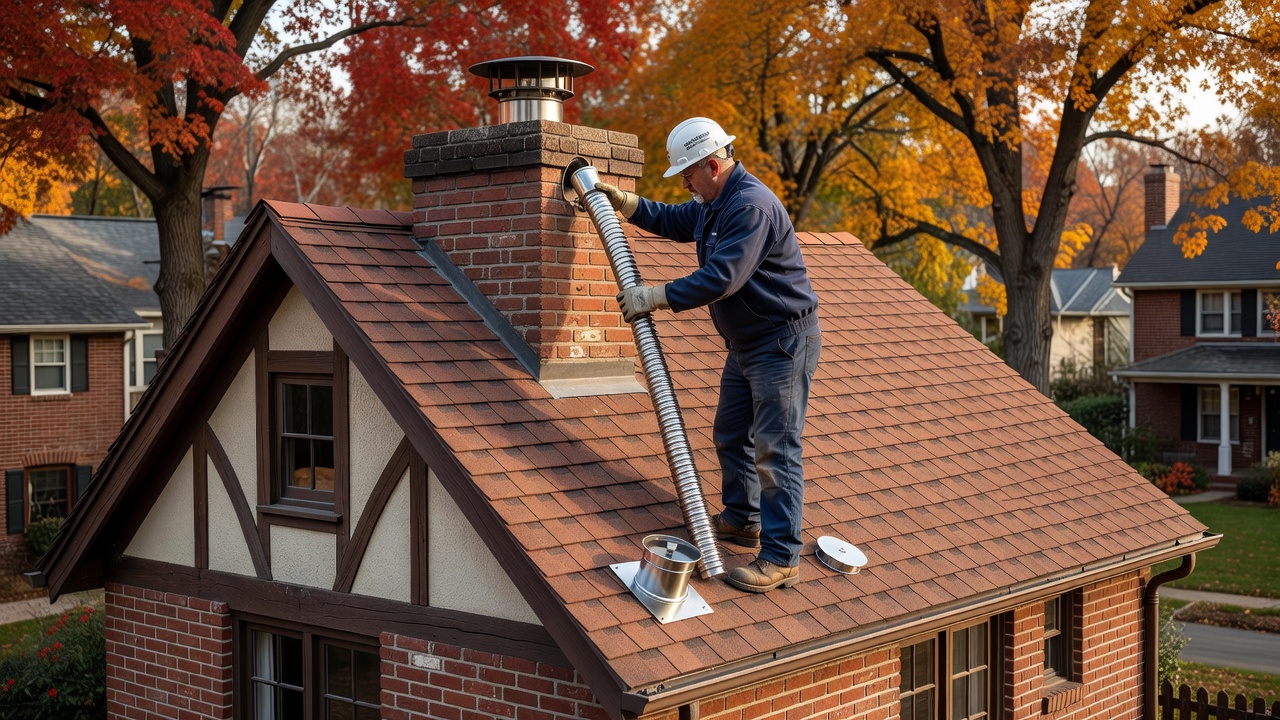
Chimney Liner Installation in Short Hills, NJ
Chimney liner installation is the process of fitting a protective sleeve typically flexible stainless steel, rigid stainless steel, or cast-in-place material inside your existing chimney flue to contain combustion gases, protect the surrounding masonry, and create a correctly sized draft channel for your appliance. Without an intact, properly sized liner, heat and toxic gases like carbon monoxide can migrate through cracked tile joints directly into your home’s framing and living spaces. For Short Hills homeowners, where Tudor, Colonial, and mid-century houses routinely have original clay-tile flues that are now 60 to 100 years old, a failing liner is one of the most common and most quietly dangerous conditions we find during annual inspections.
The Problem That Usually Starts This Conversation
Most Short Hills residents don’t call us because they already know their liner has failed. They call because their fireplace smokes back into the room, their gas insert keeps triggering its safety shutoff, or a home inspector just flagged “liner deterioration” in a pre-purchase report on a house on Hobart Avenue or Old Short Hills Road. Sometimes it’s a neighbor who mentioned they’d had the same issue. Whatever brought you here, the underlying story is almost always the same: the original clay liner has reached the end of its safe service life, or a new appliance a high-efficiency gas insert, a wood-burning stove, a pellet insert doesn’t match the dimensions of the existing flue.
Clay tile liners, installed correctly for the open fireplaces common in Essex County homes built between 1920 and 1970, simply weren’t engineered for the cooler, more acidic flue gases produced by modern gas appliances. Those cooler gases condense inside an oversized clay flue, depositing corrosive moisture that accelerates tile spalling and joint deterioration. A stainless steel liner, correctly sized to the appliance’s BTU output and flue-height requirements, solves both problems at once.
Which Liner Material Is Right for Your Situation
Not every home needs the same solution, and we’ll always explain the options before recommending one.
- Flexible 316-alloy stainless steel liner: The most common choice for existing masonry chimneys in Short Hills. The flexible corrugated tube snakes down through offsets and bends that a rigid liner can’t navigate. It’s the standard choice for gas appliances, gas inserts, and most wood-burning stoves where the existing flue has one or more offsets common in the older brick chimneys you find throughout the Millburn Township area.
- Rigid 304 or 316 stainless steel sections: Used when the flue is perfectly straight and the appliance produces higher flue temperatures typically a high-output wood-burning fireplace or a traditional masonry heater. Rigid sections offer a smoother interior surface and slightly better draft in straight runs.
- Cast-in-place liner (poured refractory): The right call when the existing masonry is structurally sound but the mortar joints throughout the entire flue are badly deteriorated. A poured liner bonds to the interior of the flue, reinforces the chimney from within, and creates a seamless, round channel. It’s more involved and costs more, but for a chimney that’s otherwise in good structural shape, it can add decades of service life.
Alloy choice matters too. We use 316Ti (titanium-stabilized) stainless for gas appliances because the higher sulfur content in gas combustion byproducts is harder on the liner over time. For wood-burning systems we use 304 or 316 depending on the appliance’s operating temperature range.
How We Actually Do the Work: Our Installation Process
Step 1 — Level II Inspection First
Before any liner goes in, we run a video scan of the existing flue. This tells us the exact internal dimensions, the location and severity of any tile breaks, the number and angle of offsets, and whether the chimney crown and smoke chamber are in acceptable condition. Skipping this step means guessing on liner diameter a mistake that creates poor draft, excessive condensation, or worse.
Step 2 — Sizing Calculation
Liner diameter is not arbitrary. We calculate the correct cross-sectional area based on the appliance’s BTU input rating (for gas) or firebox opening dimensions (for wood), the height of the flue, and the number of bends. An undersized liner restricts draft and can cause dangerous backdrafting. An oversized liner on a gas appliance causes condensation and premature liner failure. We do the math, show you the specs, and explain why we’re recommending what we’re recommending.
Step 3 — Installation Day
For flexible liner installations the most common scenario in Short Hills we attach a nose cone to the top of the liner, connect a pull rope, and feed the liner down from the roof while a second technician guides and controls the liner from the firebox opening below. The liner is connected to a top plate at the chimney crown (which also seals the flue against water and pest intrusion) and to a connector at the appliance end. We insulate the liner with a wrap or poured insulation, which improves draft performance, reduces condensation, and is required by most appliance manufacturers to maintain warranty coverage.
Step 4 — Smoke and Draft Test
Before we leave, we test the system under operating conditions. For wood-burning systems, that means a test fire. For gas appliances, we verify the connection, verify draft direction, and check for CO presence at the appliance and at register level. You get a written summary of what was installed, the liner specs, and care instructions.
Everything Included in a Standard Liner Installation
- Pre-installation video flue inspection and sizing calculation
- Flexible or rigid stainless steel liner (alloy specified to appliance type)
- Insulation wrap or poured insulation as required
- Stainless steel top plate with rain cap keeps water, leaves, and animals out
- Appliance connector and smoke chamber adapter as needed
- Smoke and draft performance test before job closeout
- Written installation record with liner gauge, alloy, and diameter for your files (useful for insurance and future inspections)
Why Short Hills Homeowners Trust Us With This Work
Short Hills sits within Millburn Township, where the housing stock is older, the chimneys are taller than average (many homes have three-story elevations), and the mix of gas, oil-converted, and wood-burning systems is as varied as the architecture. We’ve worked on chimneys in this neighborhood long enough to know what the typical flue configuration looks like in a 1930s Tudor on Chatham Road versus a 1960s Colonial closer to the Short Hills Mall corridor. That local familiarity matters when we’re calculating liner sizing and planning the installation approach.
We carry full liability insurance and workers’ compensation coverage. Our technicians are trained to CSIA (Chimney Safety Institute of America) standards. We don’t subcontract liner work to a separate crew the same people who do your inspection install your liner, so nothing gets lost in translation.
We also work with Essex County’s permit requirements. Liner installations on gas appliances typically require a mechanical permit through the Township of Millburn’s construction office. We’ll walk you through that process and pull the permit on your behalf when it’s required you won’t be left navigating municipal paperwork on your own.
Frequently Asked Questions About Chimney Liner Installation in Short Hills
My home inspector said my liner has “some spalling” — does that automatically mean I need a full replacement?
Not automatically. Hairline cracks in isolated tiles sometimes qualify for a repair approach either a brush-applied refractory sealant or a partial liner covering only the damaged section rather than a full top-to-bottom liner. It depends on how many tiles are affected, whether the damage goes through the full tile thickness, and what appliance is connected to that flue. We see “some spalling” flagged on Short Hills inspection reports frequently, and roughly half the time the right answer is a targeted repair rather than a complete liner. The video scan tells us which category you’re in.
We’re switching from an open wood-burning fireplace to a gas insert — does the existing clay tile liner have to be relined?
In almost every case in New Jersey, yes. The National Fuel Gas Code (NFPA 54) and the appliance manufacturer’s installation instructions require that the liner diameter match the insert’s flue collar size which is almost never the same as the original clay tile flue. An original clay tile flue built for an open fireplace is also typically oversized for the lower BTU output of a gas insert, leading to chronic condensation on the tile. Most gas insert manufacturers in New Jersey explicitly void their warranty if the insert is connected directly to a clay tile liner without resizing. Your liner installer should be pulling a Millburn Township mechanical permit for this work.
How long does a stainless steel chimney liner last, and what maintenance does it need?
A quality 316-alloy flexible liner, properly sized, installed with insulation, and connected to an appliance running within its design parameters, typically carries a manufacturer’s warranty of 15 to 25 years and can last considerably longer in practice. The main maintenance requirement is an annual chimney inspection a CSIA-recommended Level I inspection every year you’re actively using the appliance. The inspection checks for liner damage from thermal cycling, confirms the top plate and rain cap are intact, and catches any creosote buildup before it reaches actionable levels. Skipping annual inspections is the most common reason a liner fails earlier than expected, because minor issues (a small cap crack, a loose connector joint) become large issues when left unaddressed through multiple heating seasons.
Ready to Schedule Your Liner Installation Consultation?
If you’re dealing with a failed liner, a new appliance installation, or a pre-purchase inspection result that raised concerns, the right next step is a conversation not a commitment. We’ll schedule a video scan of your flue, walk you through the findings in plain language, and give you a written estimate that specifies the liner type, alloy, diameter, and everything included in the price. No pressure, no upselling, no vague “chimney needs work” language without specifics.
Call Short Hills Chimney or use the contact form below to schedule your inspection and liner consultation. We serve Short Hills and the surrounding Millburn Township area, and we can typically schedule within a week.
Call us today or fill out our contact form to book your chimney liner consultation.
Related from Short Hills Chimney: Chimney Sweep Services in Short Hills, NJ · Smart Chimney Cap Installation Short Hills NJ